


 Cart
Cart
 sales@molnova.com


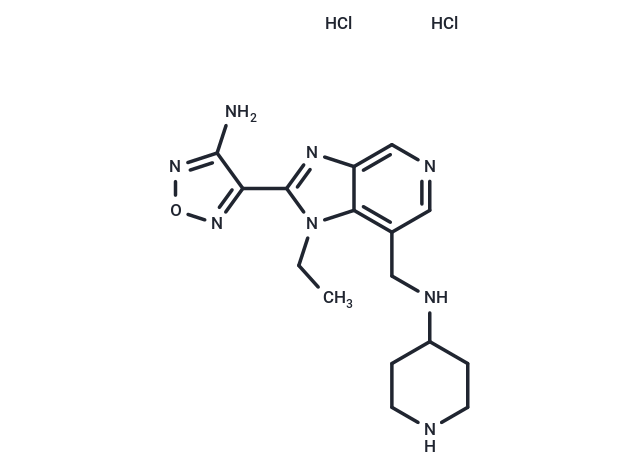
SB-747651A Dihydrochloride
CAS No. 1781882-72-1
SB-747651A Dihydrochloride( —— )
Catalog No. M37647 CAS No. 1781882-72-1
SB-747651A dihydrochloride is a chemical compound that serves as an ATP-competitive inhibitor for mitogen- and stress-activated kinase 1 (MSK1), featuring an IC50 of 11 nM.
Purity : >98% (HPLC)
 COA
Datasheet
HNMR
HPLC
MSDS
Handing Instructions
COA
Datasheet
HNMR
HPLC
MSDS
Handing Instructions
| Size | Price / USD | Stock | Quantity |
| 2MG | 102 | Get Quote |


|
| 5MG | 149 | Get Quote |
|
| 10MG | 219 | Get Quote |
|
| 25MG | 357 | Get Quote |
|
| 50MG | 509 | Get Quote |
|
| 100MG | 675 | Get Quote |
|
| 500MG | Get Quote | Get Quote |
|
| 1G | Get Quote | Get Quote |
|
Biological Information
-
Product NameSB-747651A Dihydrochloride
-
NoteResearch use only, not for human use.
-
Brief DescriptionSB-747651A dihydrochloride is a chemical compound that serves as an ATP-competitive inhibitor for mitogen- and stress-activated kinase 1 (MSK1), featuring an IC50 of 11 nM.
-
DescriptionSB-747651A dihydrochloride is an ATP-competitive mitogen- and stress-activated kinase 1 (MSK1) inhibitor with an IC50 of 11 nM. SB-747651A dihydrochloride also inhibits PRK2, RSK1, p70S6K and ROCK-II. SB-747651A dihydrochloride can be used for inflammation research.
-
In VitroSB-747651A dihydrochloride (5 μM; neutrophils) affects CXCL2-induced intraluminal crawling of neutrophils in a Mac-1-dependent manner. SB-747651A dihydrochloride thwarts the intraluminal crawling of adherent neutrophils to optimal sites of emigration. SB-747651A dihydrochloride (5 μM; neutrophils) significantly increases transmigration time and detachment time. SB-747651A dihydrochloride affects mechanisms that regulate transendothelial migration of neutrophils in response to CXCL2 chemotactic gradient. SB-747651A dihydrochloride inhibits the migration speed of extravascular chemotaxing neutrophils but does not affect their directionality in response to CXCL2 chemotactic gradient.
-
In VivoSB747651A (3 mg/kg; intrascrotal injection) dihydrochloride results in increased neutrophil adhesion 3.5~4.5 hours following stimulation with CXCL2 as compared to the effect of CXCL2.SB-747651A (3 mg/kg; i.p.) dihydrochloride affects neutrophil extravasation by increasing neutrophil emigration only at 3 and 4 hours in mouse peritonitis model of acute inflammation.Animal Model:Male C57BL/6N mice (8~16 weeks) Dosage:3 mg/kg Administration:Intrascrotal injection Result:Resulted in increased neutrophil adhesion 3.5~4.5 hours following stimulation with CXCL2 as compared to the effect of CXCL2.
-
Synonyms——
-
PathwayCell Cycle/DNA Damage
-
TargetROCK
-
RecptorROCK
-
Research Area——
-
Indication——
Chemical Information
-
CAS Number1781882-72-1
-
Formula Weight415.32
-
Molecular FormulaC16H24Cl2N8O
-
Purity>98% (HPLC)
-
SolubilityIn Vitro:?H2O : 50 mg/mL (120.39 mM; Ultrasonic)
-
SMILESCl.Cl.CCn1c(nc2cncc(CNC3CCNCC3)c12)-c1nonc1N
-
Chemical Name——
Shipping & Storage Information
-
Storage(-20℃)
-
ShippingWith Ice Pack
-
Stability≥ 2 years
Reference
1. Shaista Naqvi, et al. Characterization of the cellular action of the MSK inhibitor SB-747651A. Biochem J. 2012 Jan 1;441(1):347-57.?
molnova catalog



related products
-
CAY10746
CAY10746 is a selective Rho kinase (ROCK) inhibitor, targeting ROCK I and ROCK II with IC50 values of 0.014 μM and 0.003 μM, respectively.
-
BDP9066
BDP9066 is a potent and selective MRCK inhibitor that inhibits MRCKβ and MRCKα/β and can be used for the prevention and treatment of skin cancer.
-
Cintirorgon
Cintirorgon is a selective, oral agonist of RORγ. Cintirorgon modulates gene expression of RORγ expressing T lymphocyte immune cells.
